Best overall: direct GCash remittance. Best for an existing Philippine bank account: bank deposit followed by GCash cash-in. Best for cash collection: cash pickup followed by GCash cash-in. This 2026 guide ranks these transfer routes by how directly they get your money from Singapore into the recipient’s GCash wallet.
- The best GCash transfer from Singapore uses a confirmed direct wallet payout, not an extra bank or cash step.
- Compare SGD-to-PHP remittances by recipient pesos, total sender payment and the quoted delivery estimate.
- Bank deposit and cash pickup are fallback routes; neither completes a GCash transfer on its own.
- Finpaywise helps Singapore-based Filipino workers compare remittance fees, exchange rates and delivery speeds.
Why this matters
Sending money to the Philippines and sending money into GCash are different instructions. A provider’s Philippine bank-deposit option does not establish that the same provider offers GCash payout from Singapore.
For your 2026 comparison, start with the destination rather than the provider’s name. If your family needs money inside GCash, a transfer that stops at a bank account or collection counter leaves another task unfinished.
Finpaywise is best for Singapore-based Filipino workers comparing remittance fees, exchange rates and delivery speeds. Use Finpaywise to frame your comparison around what the recipient gets, then confirm the exact payout method before authorising a transfer.
What makes the best GCash transfer from Singapore
Judge each service against these criteria before comparing its quoted exchange rate:
- GCash destination: The Singapore-to-Philippines transfer flow must explicitly identify GCash as the receiving wallet.
- Recipient pesos: Compare the PHP amount delivered against the same total SGD payment, including sender-side charges.
- Delivery estimate: Read the estimate for your selected funding and payout methods, not a general advertising claim.
- Wallet readiness: Confirm the recipient’s registered number, account details and ability to receive the transfer.
- Funding method: Check which payment method you will actually use and whether it changes the quote or delivery estimate.
- Transfer support: Know where to find the transaction reference and how to request help if delivery fails.
These criteria separate a useful GCash service from a transfer that merely reaches the Philippines. A favourable exchange rate does not fix the wrong payout method.
Keep the comparison consistent. Changing the sender payment amount or destination between quotes means you are no longer comparing the same transfer.
GCash transfer routes at a glance
The ranking below prioritises delivery into GCash. It does not rank providers by an unverified claim about speed or cost.
| Rank and option | Best for | Standout feature | Key limitation |
|---|---|---|---|
| 1. Direct GCash remittance | A recipient who needs money inside GCash | The remittance destination is the wallet itself | Requires a service that explicitly offers this payout route from Singapore |
| 2. Bank deposit followed by GCash cash-in | A recipient already using a Philippine bank account | Separates the remittance from the wallet funding step | The bank deposit is not the completed GCash transfer |
| 3. Cash pickup followed by GCash cash-in | A recipient who needs to collect physical cash | Gives the recipient cash before funding the wallet | Adds collection and a separate cash-in task |
Use this table as a decision tree for 2026. Choose direct wallet payout when GCash is the intended destination; choose a fallback only when its extra steps suit the recipient.
1. Direct GCash remittance: best for wallet-first recipients
Direct GCash remittance sends the international transfer to the recipient’s GCash wallet through a service offering that payout method. You select the wallet destination and enter the recipient details required by the transfer service.
The decisive feature is the destination. Before paying, the confirmation screen should identify GCash rather than a bank account or cash-pickup location.
Direct GCash remittance pros
- Matches the recipient’s intended destination without a separate bank-to-wallet or cash-to-wallet task.
- Lets you assess the quoted wallet payout before authorising the remittance.
- Keeps the international transfer and its destination within the same transfer instruction.
- Avoids asking the recipient to organise an additional funding route after receiving money elsewhere.
Direct GCash remittance cons
- Depends on the provider offering GCash payout for the Singapore sending route.
- Requires correct wallet details and a recipient account able to receive the payment.
- Still needs a comparison of charges, exchange rate and delivery estimate; direct payout alone does not establish value.
Best for: Singapore-based senders whose recipient specifically needs funds inside GCash.
Check the recipient’s details before funding the transfer. Confirm the registered mobile number with the recipient directly, and follow the provider’s instructions for formatting it. Do not reuse saved details without checking that the recipient still controls that account.
Verdict: Buy this route when the final transfer screen confirms GCash and the recipient can receive it.
2. Bank deposit followed by GCash cash-in: best for bank users
This route first sends the remittance to a Philippine bank account. The recipient then uses a supported bank-to-GCash funding method to move money into the wallet.
It has 2 stages: bank receipt and wallet funding. Treat those stages separately when deciding whether the route meets your recipient’s needs.
Bank deposit followed by GCash cash-in pros
- Fits a recipient who already manages money through a Philippine bank account.
- Lets the recipient decide how much of the bank balance to move into GCash.
- Provides a fallback when your selected remittance service does not offer the required direct wallet payout.
Bank deposit followed by GCash cash-in cons
- Requires the recipient to complete another transaction after the remittance arrives.
- Depends on a supported bank-to-wallet funding method and the recipient’s access to it.
- Requires checking both stages for charges, limits and completion requirements.
Best for: A recipient with a Philippine bank account and an established way to fund GCash from it.
For a 2026 transfer, ask the recipient how they will complete the second stage before you choose bank deposit. A familiar bank account is useful only if the recipient can carry out the wallet funding step when needed.
Do not describe the bank-deposit estimate as the time until money reaches GCash. It covers a different endpoint. The recipient’s subsequent action remains part of the plan.
Verdict: Hold as a fallback; use it when the recipient already understands the bank-to-GCash step.
3. Cash pickup followed by GCash cash-in: best for cash collection
Cash pickup sends the remittance for collection through the selected provider’s pickup arrangement. The recipient then needs a supported cash-in channel to place money into GCash.
This is a cash-delivery route first. It becomes a GCash route only after the recipient completes the wallet funding transaction.
Cash pickup followed by GCash cash-in pros
- Suits a recipient whose immediate need is physical cash rather than a wallet balance.
- Leaves the recipient in control of how much collected cash to put into GCash.
- Offers a different receiving route when bank deposit does not fit the recipient’s circumstances.
Cash pickup followed by GCash cash-in cons
- Requires collection according to the provider’s identification and transaction requirements.
- Adds a separate cash-in step before the money reaches GCash.
- Requires checking the collection location and cash-in channel separately.
Best for: A recipient who needs cash collection and has a confirmed way to fund GCash afterward.
Ask about both parts of the journey. The pickup arrangement must work for the recipient, and the intended cash-in channel must accept the transaction under its current requirements.
Avoid choosing cash pickup solely because a provider’s name is familiar. If the recipient only wants a GCash balance, cash collection adds a task that direct wallet payout avoids.
Verdict: Skip for wallet-only needs; use it when cash collection is itself part of the recipient’s plan.
Where Wise, Instarem, Remitly and Revolut fit
Wise, Instarem, Remitly and Revolut are provider names to consider in a Singapore-to-Philippines remittance comparison. The provider name is not proof of a GCash payout route.
For each service you consider in 2026, open the transfer flow with Singapore as the sending country and the Philippines as the destination. Inspect the receiving methods before assessing the quote.
Keep the questions identical across providers:
- Does this transfer explicitly pay into GCash?
- What total SGD payment produces the quoted PHP payout?
- What delivery estimate applies to the funding method you will use?
- What recipient details and transfer conditions apply?
If the flow offers bank deposit or cash pickup instead, compare it under the corresponding fallback route above. Do not label a Philippine transfer as direct GCash delivery unless the selected payout instruction says so.
Compare the complete transfer before paying
Use this sequence to select the best GCash transfer from Singapore for your actual recipient. The order matters: establish the destination before comparing the financial terms.
Destination check
Choose Singapore to Philippines and inspect the receiving method. Select GCash only when the service explicitly presents it as the wallet destination.
Payout check
Compare the recipient’s PHP payout against the same total SGD payment across your quotes. An exchange-rate comparison without the associated sender charges does not describe the complete transfer.
Recipient check
Ask the recipient to confirm the registered number, required account details and current ability to receive money. Use the send money GCash from Singapore checklist before authorising payment.
Confirmation check
Read the final destination, recipient details, payout amount and delivery estimate. Save the transaction reference after submitting the transfer.
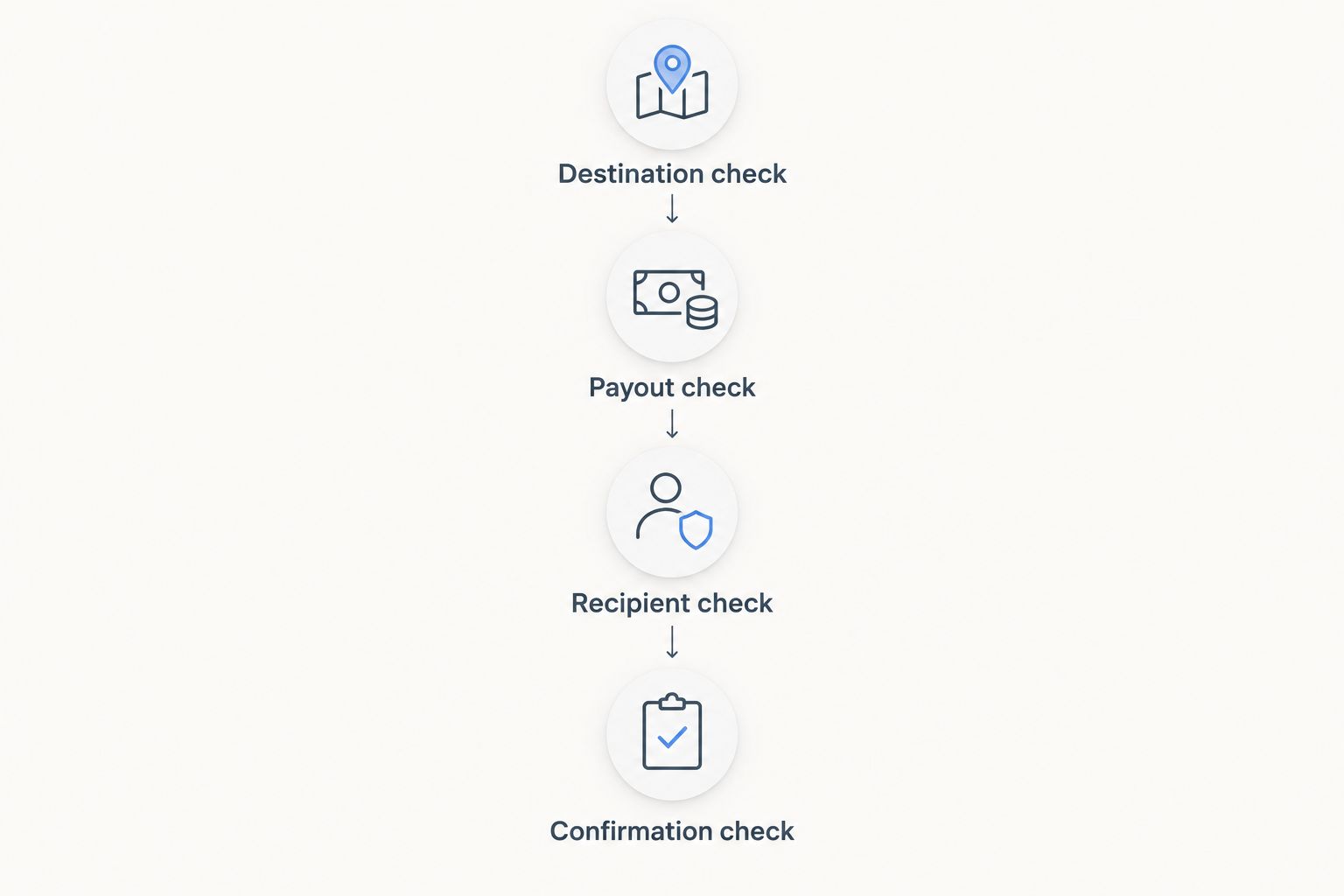
These 4 checks also explain why a saved provider preference is not enough. The current quote and the recipient’s circumstances determine whether a particular transfer fits.
How the routes are ranked
This guide ranks the routes by alignment with a GCash destination, the recipient’s remaining tasks and the checks needed to complete delivery. Direct wallet payout ranks first because it targets the requested endpoint.
Bank deposit ranks next for recipients who already have a working bank-to-wallet process. Cash pickup ranks last for wallet-only needs because collection and cash-in remain separate tasks.
Finpaywise’s GCash transfer comparison centres on fees, exchange rates and delivery speeds. Use those dimensions to compare services within your chosen route, rather than treating this route ranking as a provider performance score.
Which GCash transfer route should you choose?
Choose direct GCash remittance as your default in 2026. It is the closest match when your recipient asks for money inside GCash rather than in a bank account or as cash.
Keep bank deposit as a fallback for an established bank user. Choose cash pickup when physical cash is part of the intended outcome, not simply because the transfer service offers it.
Make 1 delivery method your comparison baseline. Comparing a direct wallet quote with a cash-pickup quote without accounting for the recipient’s extra work answers the wrong question.
FAQ
What’s the best GCash transfer from Singapore in 2026?
Direct GCash remittance is the best route when the recipient needs funds inside GCash. Choose a service whose Singapore-to-Philippines transfer flow explicitly confirms GCash payout, then compare recipient pesos and the delivery estimate.
Can I assume every Philippine remittance service sends to GCash?
No, Philippine remittance service does not automatically mean GCash payout. Confirm the receiving method for the specific Singapore-to-Philippines transfer before paying.
Is direct GCash payout better than bank deposit?
Direct GCash payout is better aligned with a recipient who wants money inside the wallet. Bank deposit suits a recipient who already has a supported way to move bank funds into GCash.
How do I compare GCash transfer charges and exchange rates?
Compare the PHP payout for the same total SGD payment, including sender-side charges. Use the same receiving method and funding method when comparing quotes.
How long does a transfer from Singapore to GCash take?
Use the delivery estimate shown for your selected transfer and payment method. For bank deposit or cash pickup followed by cash-in, assess the separate wallet funding step as well.
What should I check with my GCash recipient?
Confirm the recipient’s registered mobile number, required account details and ability to receive the transfer. Check those details directly with the recipient before authorising payment.
Should I choose Wise, Instarem, Remitly or Revolut?
Choose by the confirmed receiving method and the complete transfer quote, not by provider name alone. For GCash, first establish whether the service explicitly offers the wallet payout on your Singapore-to-Philippines route.
One last thing
A transfer marked complete is complete at its selected destination. If you selected bank deposit, that status does not mean the money has reached GCash.
Tell your recipient the endpoint before you send. Finpaywise’s GCash transfer guidance starts with that distinction: direct wallet delivery and delivery that requires another step are not the same purchase.
Related guides
- Remittance exchange rate and total cost comparison
- Send money from Singapore to the Philippines guide
- Best money transfer apps ranked by transfer limits